A missing arrow is easy to overlook in a flowchart, and a tracking table can fall behind the specification. stagemap keeps cards, links and stages in R tables, draws them as a map and checks them in code. The map shows in the R console viewer, in Quarto and R Markdown documents and in Shiny apps.
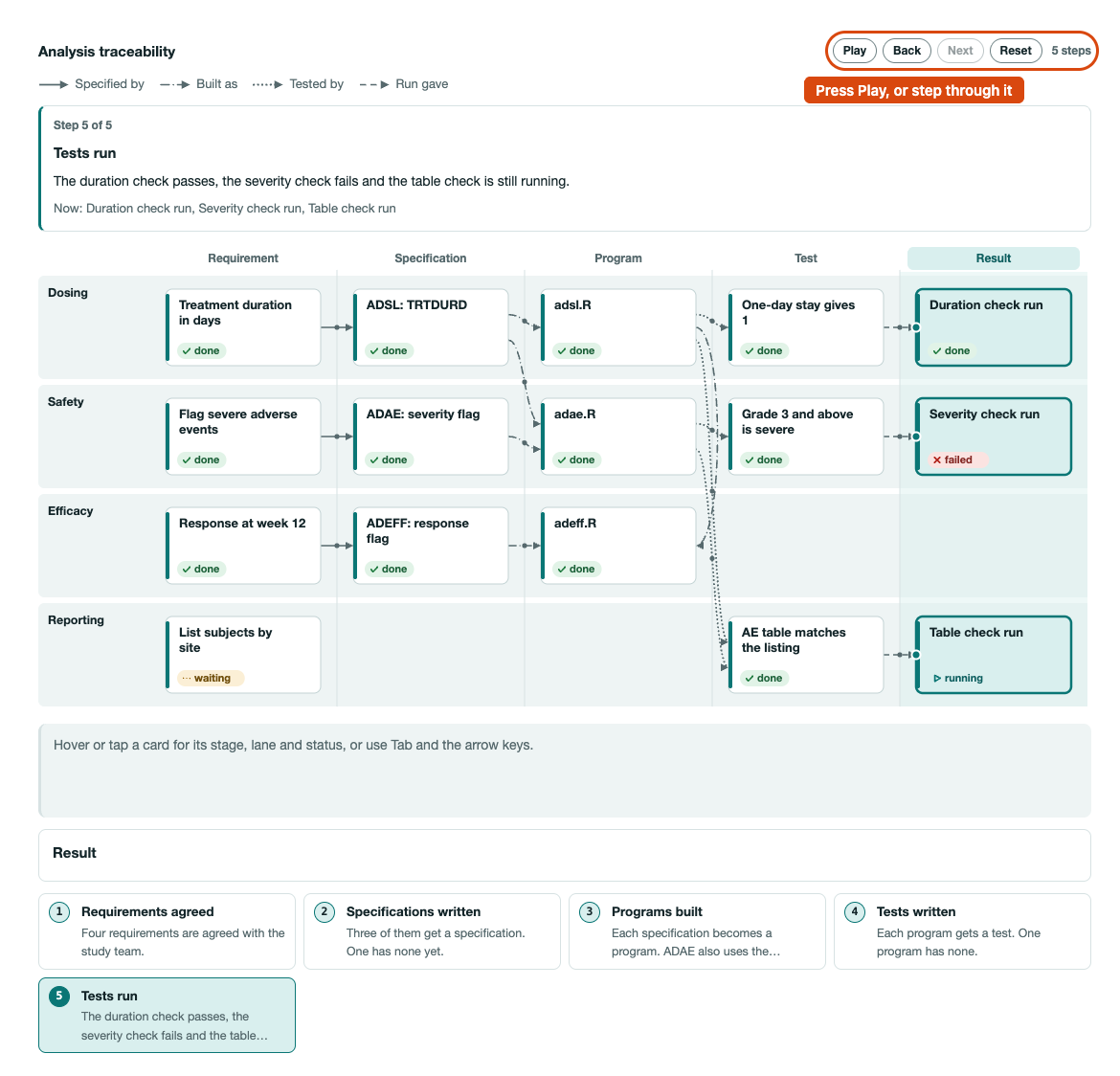
The map plays as a story: press Play, or step through it with Back and Next, and the cards change as each stage is reached. Two cards stand out: “List subjects by site” has no link, and the Efficacy program has no test. Several arrows cross from one lane to another.
Installation
stagemap needs R 4.1.0 or later. Install the development version from GitHub.
# install.packages("pak")
pak::pak("insightsurge/stagemap")
A first map
Six small tables describe the map: the cards, the links between them, the kinds of link, the stages, the steps of the player and the changes each step makes to the cards.
library(stagemap)

cards <- data.frame(
  id = c(
    "req_dur", "req_ae", "req_eff", "req_site",
    "spec_dur", "spec_ae", "spec_eff",
    "prog_adsl", "prog_adae", "prog_adeff",
    "test_dur", "test_ae", "test_tbl",
    "run_dur", "run_ae", "run_tbl"
  ),
  label = c(
    "Treatment duration in days", "Flag severe adverse events", "Response at week 12", "List subjects by site",
    "ADSL: TRTDURD", "ADAE: severity flag", "ADEFF: response flag",
    "adsl.R", "adae.R", "adeff.R",
    "One-day stay gives 1", "Grade 3 and above is severe", "AE table matches the listing",
    "Duration check run", "Severity check run", "Table check run"
  ),
  stage = rep(c("requirement", "specification", "program", "test", "result"), c(4, 3, 3, 3, 3)),
  lane = c(
    "Dosing", "Safety", "Efficacy", "Reporting",
    "Dosing", "Safety", "Efficacy",
    "Dosing", "Safety", "Efficacy",
    "Dosing", "Safety", "Reporting",
    "Dosing", "Safety", "Reporting"
  ),
  status = c("done", "done", "done", "waiting", rep("waiting", 12))
)
links <- data.frame(
  from = c(
    "req_dur", "req_ae", "req_eff",
    "spec_dur", "spec_ae", "spec_eff", "spec_dur", "prog_adsl",
    "prog_adsl", "prog_adae", "prog_adae", "prog_adsl",
    "test_dur", "test_ae", "test_tbl"
  ),
  to = c(
    "spec_dur", "spec_ae", "spec_eff",
    "prog_adsl", "prog_adae", "prog_adeff", "prog_adae", "prog_adeff",
    "test_dur", "test_ae", "test_tbl", "test_tbl",
    "run_dur", "run_ae", "run_tbl"
  ),
  kind = c(
    rep("specified", 3),
    rep("built", 5),
    rep("tested", 4),
    rep("result", 3)
  )
)
kinds <- data.frame(
  id = c("specified", "built", "tested", "result"),
  label = c("Specified by", "Built as", "Tested by", "Run gave"),
  line = c("solid", "dashdot", "dotted", "dashed")
)
stages <- data.frame(
  id = c("requirement", "specification", "program", "test", "result"),
  label = c("Requirement", "Specification", "Program", "Test", "Result")
)
steps <- data.frame(
  id = c("agreed", "specified", "built", "tested", "run"),
  label = c("Requirements agreed", "Specifications written", "Programs built", "Tests written", "Tests run"),
  stage = stages$id,
  text = c(
    "Four requirements are agreed with the study team.",
    "Three of them get a specification. One has none yet.",
    "Each specification becomes a program. ADAE also uses the duration rule, and ADEFF reads ADSL.",
    "Each program gets a test. One program has none.",
    "The duration check passes, the severity check fails and the table check is still running."
  )
)
changes <- data.frame(
  step = c(rep("specified", 3), rep("built", 3), rep("tested", 3), rep("run", 3)),
  card = c(
    "spec_dur", "spec_ae", "spec_eff", "prog_adsl", "prog_adae", "prog_adeff",
    "test_dur", "test_ae", "test_tbl", "run_dur", "run_ae", "run_tbl"
  ),
  status = c(rep("done", 9), "done", "failed", "running")
)
map <- stage_map(cards, stages, title = "Analysis traceability") |>
  add_links(links, kinds = kinds) |>
  add_steps(steps, changes = changes, intro = "Follow one analysis from requirement to result.")

map
One step more
Ask the same map object which requirement has no specification, which program has no test, or what one requirement reaches downstream.
sm_missing(map, "requirement", linked_to = "specification")
#>         id                 label       stage      lane
#> 1 req_site List subjects by site requirement Reporting

sm_missing(map, "program", linked_to = "test")
#>           id   label   stage     lane
#> 1 prog_adeff adeff.R program Efficacy

sm_trace(map, "req_ae")[, c("id", "stage", "direction", "distance")]
#>          id         stage  direction distance
#> 1    req_ae   requirement      start        0
#> 2   spec_ae specification downstream        1
#> 3 prog_adae       program downstream        2
#> 4   test_ae          test downstream        3
#> 5  test_tbl          test downstream        3
#> 6    run_ae        result downstream        4
#> 7   run_tbl        result downstream        4
Why
A week before a review, a programmer is asked which study requirements have no test. When the links live in a slide and a spreadsheet, the answer means cross-checking by hand. With cards and links in R, the map and the checks read the same tables, so the answer is a function call and a highlighted card. The map and the checks help reviewers inspect links; qualification of the software stays with your own procedures.
The studio
stage_map_studio() opens a Shiny app where you click a card, a stage, a lane or a link and change it in a form. The app keeps a journal with Undo, runs sm_trace(), sm_orphans() and sm_missing() on the map, shows what stops stage_map() and how to fix it, and writes the R code for every change. Done gives the map back to R.
map <- stage_map_studio(map)Exports
| Job | Functions |
|---|---|
| Draw |
stage_map(), add_links(), add_zones(), add_steps(), add_variants() (experimental) |
| Ask |
sm_trace(), sm_orphans(), sm_missing()
|
| Read back |
stage_map_tables() (the tables a map holds), stage_map_code() (the R code that builds it) |
| Shiny |
stage_map_output(), render_stage_map(), stage_map_proxy(), stage_map_select(), stage_map_highlight(), stage_map_show() (experimental), stage_map_hide() (experimental), stage_map_enable() (experimental), stage_map_disable() (experimental) |
| Studio |
stage_map_studio() (experimental): change a map through forms in an app, ask it questions, check it, copy its R code, and take the map back to R |
Read the Get started article (vignette("stagemap")) for zones, steps and Shiny, or run the demo app with shiny::runApp(system.file("examples", "shiny-demo", package = "stagemap")).
Status
Early development; stagemap is the working name, and the package is not on CRAN. Experimental: add_variants(), the "levels" and "dates" layouts with target and variant, stage_map_show(), stage_map_hide(), stage_map_enable(), stage_map_disable() and the input$<id>_hovered Shiny input. The rest is meant to stay, but names and arguments can still change before the first release. Writing a static image is not built yet.
The coverage badge counts the R code the tests run. The JavaScript engine that draws the maps in the browser is tested there and is not part of that figure.
Contributing
Open an issue with one of the issue forms before starting work. The contributing guide is in .github/CONTRIBUTING.md.